
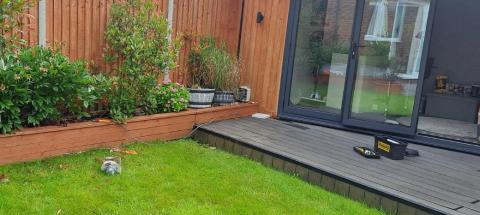
A recent garden lighting fault in Himley Way, Amington, is a good example of how these problems usually unfold. The customer had ten uplights set into the ground under bushes and shrubs, each connected through its own ground box. The lights had worked fine for a couple of years, then suddenly every time they were switched on, they tripped the RCD in the garden building and another RCD back at the main consumer unit.
That sort of fault needs methodical testing, not guesswork. I started by identifying that the circuit was protected by two RCDs, one of which also protected several important circuits in the house. The supply run was in SWA cable, so we moved the MCB away from unnecessary RCD protection – as it is mechanically protected by the steel wire. The fault remained which told us the problem was further along the garden lighting circuit.
How I Find Garden Lighting Faults
With fault finding, the fastest route is usually to split the circuit into sections. I divided the garden lighting run halfway to see whether the fault was in the first half or the second. It still tripped, so the problem was in the first half.
The difficult part was access. The lights and connector boxes were hidden under soil, leaves, plants and shrubs. I disconnected the circuit cable from the Wi-Fi controller first, because test currents could damage it. Then I worked from the garden room wall box towards the first buried lighting box.
Using my MFT multi-function tester, I carried out insulation resistance testing to check for damage, damp, and unwanted contact between conductors. Several boxes had damp inside, showing they were not properly waterproofed. Some connections were in poor condition, with barely any effective insulation between cables.
Opening and checking boxes and connection
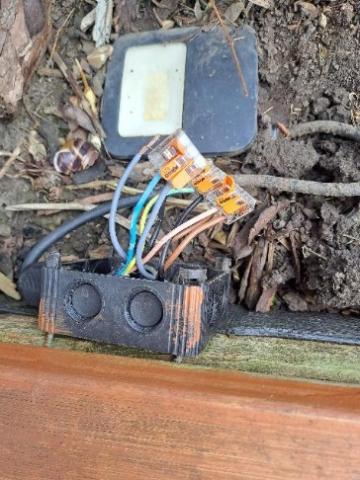
After running a temporary cable replacement, between 2 of the suspect boxes, the circuit worked correctly. The final hidden problem was an extra buried light behind bushes that the customer knew about, but I had not yet found.
Here’s what we found
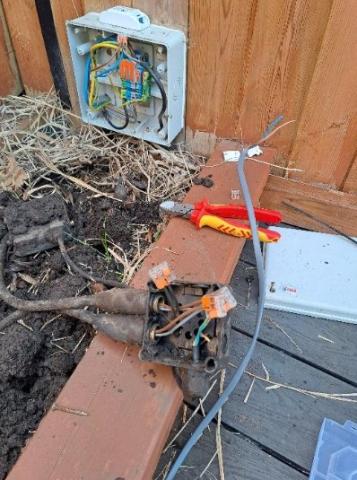
Once dug up, it had wet contacts. I refitted the cabling into a new box and moved the box and light to a nearby fence. Problem solved.
What’s Included
For garden lighting fault finding in Tamworth, I usually allow around 2 to 4 hours for the initial testing and diagnosis. The inspection includes testing the affected circuit, checking fittings and connection points, and identifying whether the fault is caused by water ingress, damaged cable, failed fittings, poor joints or previous DIY work.
Materials and repair work may be quoted separately once the fault has been found.
Why These Faults Happen
The most common problems I see are damp connection boxes, poor glands, damaged buried cable, unsuitable joints, and outdoor fittings that were never properly protected from the weather. Some DIY or cowboy work will function for a while, then fail once water, movement or corrosion catches up with it.
What to Expect
I offer a free consultation visit and quote. If you want to go ahead, we agree a convenient date, carry out the troubleshooting visit, and either complete the fix or provide a clear quote for any extra repair work needed.
I am NAPIT registered, NVQ Level 3 qualified, and have over 90 five-star reviews. Workmanship is guaranteed for 12 months, with manufacturer parts warranties where applicable.
Pricing
Garden lighting fault finding is usually from £250 after the free survey and quote. You will know what you are paying for before work begins.
Need Garden Lighting Fault Finding Near Me?
If your garden lights are tripping the RCD, failing after rain, or have stopped working altogether, call Carl at Tamworth Electricians on 01827 799 876
- Log in to post comments