
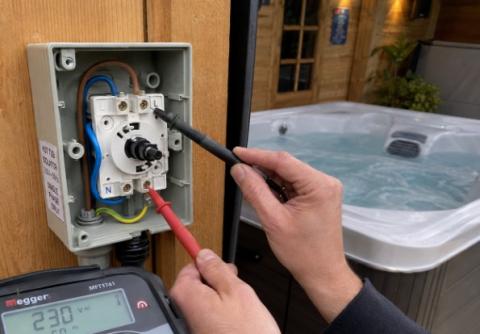
I recently attended a relatively new garden building installation in Glascote in Tamworth, after the owner lost power to their hot tub. As soon as I walked into the garden building, I could smell something faintly burning.
The RCD in the garden building had tripped and the hot tub had stopped working. I started tracing the smell and found it became noticeably stronger as I moved towards the rotary isolator supplying the hot tub.
When I opened the isolator, I found that one of the terminals had melted.
The screw securing the cable had not been tightened properly. That poor connection had allowed arcing, or sparking, across the contact points. This creates intense localised heat and can quickly damage terminals, switches and surrounding plastic. Temperature of 300C and up are known to happen during arcing.
In this case, the damage had interrupted the supply before the fault developed any further.
I tested the cable to make sure the heat had not damaged it. Fortunately, the cable tested correctly. I sourced replacement terminals, repaired the isolator and then tested the circuit again before restoring the supply. Everything was then working correctly and the hot tub was back in use.
That job is a good example of why I take a burning smell from a socket or switch in Tamworth and surrounding areas seriously, even when the electrical installation itself is fairly recent.
What causes a socket or switch to smell burnt?
One of the first things I check is the quality of the electrical connections.
A properly made connection should remain secure and carry its intended current without becoming excessively hot. If a terminal screw works loose, or was never tightened sufficiently in the first place, resistance builds at that connection. The terminal then begins to heat.
Arcing can make the problem considerably worse. Electricity starts jumping across a poor connection and creates very high temperatures in a very small area.
The damage can start behind the fitting where you cannot see it.
You might only notice a faint smell at first. Sometimes the socket or switch feels warm. There may also be buzzing, crackling, intermittent operation or a circuit breaker or RCD that starts tripping.
By the time you can see brown marks or melted plastic, the connection may already have been overheating for some time.
Cheap electrical accessories can cause problems
I also come across problems with lower-cost electrical equipment, particularly on installations carrying relatively high loads.
Some cheaper switches, isolators and accessories use smaller terminals and lower-quality screws. I have found screws that start to bend or deform when tightened, which makes it difficult to achieve a secure connection.
That matters when an accessory is supplying equipment with a high demand for power (kW).
A terminal might appear secure when the installation is completed but still fail to grip the conductor properly. Once the appliance starts drawing current for extended periods, that poor connection can begin heating.
The Glascote isolator showed exactly what can happen when a terminal connection is not good enough.
Garden buildings and hot tubs need the right electrical equipment
I am seeing more garden buildings and hot tubs being installed around Tamworth.
With the increasing cost of moving house, plenty of homeowners are staying where they are and making better use of the space they already have. Garden buildings are being converted into offices, bars and workspaces, while hot tubs are being added to gardens that previously saw relatively little use.
Those additions can introduce substantial new electrical loads.
If you are installing a garden building or hot tub, the cable size, protective devices, isolators and accessories all need to suit the equipment being supplied. The quality of the connections matters just as much.
A newer installation is not automatically free from faults. The installation in Glascote was relatively recent, yet one poor terminal connection had already generated enough heat to melt part of the isolator.
What should you do if you smell burning?
If you notice a burning smell from a socket or switch in Tamworth and surrounding areas, stop using the affected equipment.
If you can safely identify the circuit at the consumer unit, switch it off. I would not keep resetting an RCD or circuit breaker that continues to trip.
I would also avoid removing the socket, switch or isolator yourself. The visible accessory may only show part of the damage.
When I investigate this type of fault, I want to establish what caused the overheating and whether anything else has been affected.
On this job, replacing the melted terminal alone would not have been enough. I also tested the cable before putting the circuit back into service. That confirmed the fault had remained local to the isolator and had not damaged the cable supplying it.
Electrical fault finding in Tamworth
I have seven years' experience as an electrician, hold a C&G NVQ Level 3 in Electrical Installations and I am NAPIT registered.
I carry out troubleshooting and electrical repairs throughout Tamworth and the surrounding areas, including faults involving sockets, switches, garden power supplies and hot tub installations.
Tamworth Electricians has more than 90 customer reviews, and fault-finding work starts from £150.
I also make the cost clear before additional work begins. If a repair is required, you receive a written quote detailing exactly what you are paying for.
If you have a burning smell from a socket or switch in Tamworth and surrounding areas, or another electrical problem that needs sorting out, call me and I will be happy to take a look.
- Log in to post comments